I've had some time to ponder this past Wednesday's ExecutiveBiz New New Internet conference in McLean, Virginia. It was organized by Dion Hinchcliffe and other Web 2.0 luminaries to discuss corporate applications of a wide range of collaboration, social networking, and software development technologies and processes.
Given the difficulty of doing Return on Investment (ROI) analysis for IT projects, how do you justify an Enterprise Web 2.0 project?
In a comment he left on my How Much Will Your Enterprise Web 2.0 Project Cost? post, Vinnie Mirchandani suggested that one place to start would be to look at the criteria used in the past for evaluating large IT investments.
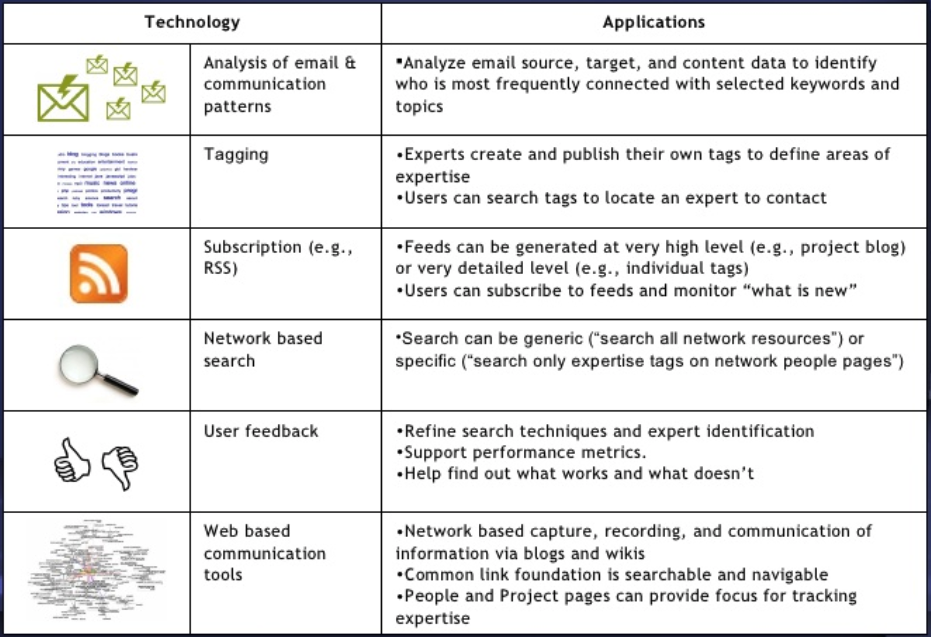
Proposed Definition for "Expertise Management Systems"
In a recent slide presentation I proposed the following as a definition of an “expertise management system:”
Washington Post Staff Writer Rick Weiss reported on September 13 that a major Federal Government-wide electronic grant submission system operated by Department of Health and Human Services requires a Windows computer to access the web site, Grants.gov.
Prompted by conversations with government contractors in the Washington DC area I’ve created a brief (and very high-level) slide presentation that lays out some of the basics of what I’ve been calling “expertise management systems.”
After Wikipedia's editing caused premature deletion of an evolving Enterprise 2.0 article (the correct term is now "enterprise social software"), I decided to investigate the costs associated with Web 2.0 applications in the enterprise.
Tom Mohr in Winning Online - a Manifesto provides a sobering view of the challenges newspapers face in adjusting to a Web 2.0 world where online advertising revenue today still accounts for less than 6% of total annual newspaper advertising revenue -- and total advertising revenue is declining.
Earlier this month in my post What is the Minimum Information You Need to Describe Your IT Projects? I mentioned that a “RACI” statement is a useful way to communicate project responsibilities:
* Who has ultimate Responsibility, who has Authority to make decisions, who must be Consulted about major actions or decisions, and who must be Informed about major actions or decisions.
One blog I read is the Microsoft Knowledge Network Team Blog (registration required). It describes development and features of the "Knowledge Network" product that will accompany Microsoft's upcoming Microsoft Office SharePoint Server 2007 which is also in Beta status.
When considering the potential system integration costs of an enterprise web 2.0 project, one of the first things to do is to identify potential system-related “ripple effects” (if any) of introducing an enterprise web 2.0 system into the organization. We also need to consider the cost implications of addressing and managing these ripple effects over time.
Professor Andrew McAfee has an excellent series of posts related to the application of “return on investment” (ROI) calculations to enterprise IT. His posts deserve a close reading. He gets some flack for seeming to argue against measurement, but as he explains in his second post, that’s not his point; he’s basically saying that too many business cases that rely on a haphazard or incomplete calculation of IT benefits are flawed, incorrect, incomplete, or self serving.
The title refers to the Wikipedia article that was begun last week and mentioned by Andrew McAfee in his blog. It was a brief article that repeated a few of McAfee's ideas and began listing some relevant links. Recently, though, someone deleted the Enterprise 2.0 article. Gone.

The CIO in a Large Financial Services Firm Discusses "Baby Boomer Brain Drain" and His Real Staffing Concerns
Several things stand out based on this interview with Oscar in combination with information gleaned from my previous interviews and research:
There's a great series of comments over on the Freedom To Tinker blog regarding Ed Felten's post DRM Wars: The Next Generation. The post and the comments provide good insight into where arguments and enforcement efforts are headed.
Rod Boothby (or someone using Rod’s name) recently stopped by and left the following comment attached to my recent accelerating network effects post:
In Documentation Redux - a Shorthand Proposal Framework, and the PMO Surprise fellow blogger James P. MacLennan proposes a basic “table of contents” for the most basic information about projects that an IT department should have:
Dave Morgan’s Doomed Page Views argues that measuring “page views,” given the rise of RSS and related feed technology in the online world, will be obsolete within two years as a way to measure the reach that a web publisher (and by, extension, the ads served by that publisher) have with respect to communicating with an audience.
IBM’s Luis Suarez in 5 Key Steps towards Adopting Web 2.0 within the Enterprise provides a pragmatic and experience-based list of five tips on how to introduce Web 2.0 technologies into the enterprise.
The IT Director in a Large Manufacturing Company Discusses "Baby Boomer Brain Drain"
Last week I interviewed “Ferris” (not his real name) about how his company is handling the pending retirement of senior IT staff.
Ferris is the IT Director in a large manufacturing company. Ferris’ company doesn’t have the mix of custom legacy Cobol and Assembler based mainframe systems that Boris the Insurance Company CIO has.