Jeremiah Owyang’s LiveBlog: What’s Wrong with the White Label Social Networking Industry?, especially if you read the comments, delivers a good snapshot of the gaps that still exist between product evangelism and the realities of implementing specialized online social networks.
In a nutshell, the participants at this “unconference” event seem to be saying that there is a gap between the selling of online social networking products by vendors and the actual implementation over time by the customer of services using that product.
At the end of the day, in one example I’ve heard in my own research, the social network manager has to deal with the recalcitrant VP who refuses to give up emailed attachments even in the face of waves of employees using more efficient collaborative tools. “Resistance to adoption” has many such components.
Depending on your vantage point, such resistance factors can make a lot of sense to those involved, even though they drive up the complexity and costs of the adoption process.
One hobby-horse of mine is the need to understand the costs of what is being implemented. Some vendors — and evangelists — are fond of saying “…how inexpensive social networking software and services are in relation to other enterprise level systems.”
Oh, yeah? The following fictional pie chart is from a slide I use when I’m presenting on social media in large organizations. The total circle represents costs, and the breakdown is between technology related costs (e.g., what the vendor charges you for the product or service) and the process related costs (e.g., the cost of staff time — yours or the vendor’s integration charges — needed to get the product implemented and into operation):
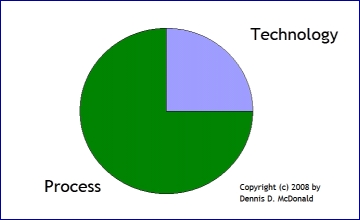
One of the problems is that this breakdown is going to differ from implementation to implementation. It’s one of those situations where “one size does not fit all.” Everyone seems to have a different perspective on what goes into each numerator and denominator.
One reason for this complexity is that the industry is still at a point where it’s common to compare apples and oranges. An excellent example is presented in Carlos Caballero’s post titled Evernote: new collaboration modality emerging or just note taking? What is your workspace vision? The author outlines how approaches to social networking technology in the enterprise can differ so much:
So, we can see that several patterns emerge as we differentiate philosophies of workspaces:
- Interaction modalities – Rich, abundant, complex, or mostly asynchronous
- Attention focus – Individually produced documents, collaborative documents, and users
- How is content created – Mostly individually, on the desktop, or collectively, on line.
- Copyright (c) 2008 by Dennis D. McDonald
- Need help estimating costs? Email me at ddmcd@yahoo.com