No Such Thing as Free Access: Can AI Reduce Friction in Scholarly Communication?
“Free” research access still depends on a complex web of people, institutions, systems, and shared values. Can AI help reduce friction in the system?"
Someone has to pay
Whether we’re talking about access to research data or publishing research results in peer reviewed journals, someone has to pay for:
The research that generates the data.
The meetings and conference presentations.
The research articles and how they are reviewed and published.
The systems used to store, retrieve, and disseminate research results and data.
Management and operation of the myriad of public and private sector organizations tied to (1) through (4).
System breakdown
The Science article “U.S. agencies aren’t ready for the rising cost of making research papers free, report warns” warns that a complex and decentralized network of public and private institutions may show signs of breaking down when one or more of the entities responsible for managing the flow of information realizes that its costs are outstripping its resources. Something has got to give. This shows up in higher prices, reduced access - or people seeking alternative means for disseminating information.
On the one hand, as the Science article reports, some US research agencies are required to make the results of their research available to the public “for free.” At the same time, those same research agencies are reducing their support for research! Given the hodgepodge of institutions involved in conducting, reporting, and disseminating research, impacts will be felt all along the “research dissemination lifecycle,” including:
Cutbacks in research funding will reduce the generation of data and reports that require management and dissemination.
Researchers may seek alternative and less expensive means for report and data dissemination.
New, less expensive - and potentially lower quality - methods for distributing research findings will be tried out.
Someone, inevitably, will try to game the system to take advantage of lowered security or quality control.
A silver lining
Before we all go “doom and gloom,” I would like to think there is a silver lining to all this: crises can force renewed attention to how the overall system works. I also believe a serious consideration is in order of how AI might help to overcome some of the system’s overall operational deficiencies.
Ties to the past
The current model still operates with much of the same components as its original 18th and 19th century beginnings:
Continued reliance on peer reviewed journals.
Gatekeeping by professional societies.
Funding for time and materials by a multitude of public and private institutions.
Technology has significantly expanded the size, scope, and speed of the system over the years; yet, how the different components interact and transfer information from one participant to another still involves friction and inefficiencies. We see that happening now as the costs of making access “free” emerge as an issue given how government research cutbacks ripple through the system.
Beyond belt-tightening
It’s time to think beyond belt-tightening. We need to consider how AI can help streamline how information gets from its origin to potential users. If that means re-thinking how research information gets packaged and bundled outside traditional gatekeeping institutions like journals, libraries, and publishers, so be it.
The greatest impediment
Perhaps the single greatest impediment to using AI to streamline how this system operates is the lack of transparency in how the system currently operates. No one really has a complete understanding of how all these components interact and how much they cost. Even the language used to describe system operation can be deceptive; for example, making access “free” is a misnomer when someone at some point must absorb the cost of doing so.
Need to know?
A key question is, does AI really need to understand the details of how all these components operate? Or, can it learn while it observes how the different components interact, then use that learning to devise more efficient paths for information to travel?
This question is similar to one I asked in “Managing the Flow Chart: AI, Complexity, and Control,” with its reference to Sangeet Paul Choudary’s HBR article “AI’s Big Payoff is Coordination, Not Automation.” The idea is that AI might be able to help coordinate component interactions without needing to know the details of how individual system components are managed. Perhaps it would be more important for the AI to understand how the priorities and business processes they support interact.
Serious challenges
Transitioning to AI-supported coordination for communicating research findings would not be a trivial challenge. I would first want to model the process, which would then be simulated to examine a variety of options. This would then be followed by a prototyped system that is controlled and carefully scoped.
Why things DO work
One final comment. Our current mix of systems and practices for communicating research findings works, despite its inefficiencies and incompatibilities, because of shared values. Participants believe that research needs to be shared. That’s a fundamental part of science. Scrutiny by one’s peers of research findings is sacrosanct. But if personal incentives, selfishness, or politics get in the way, the system breaks down, regardless of whether AI is viewed as a boon or a demon.
Copyright (c) 2026 by Dennis D. McDonald
Addendum
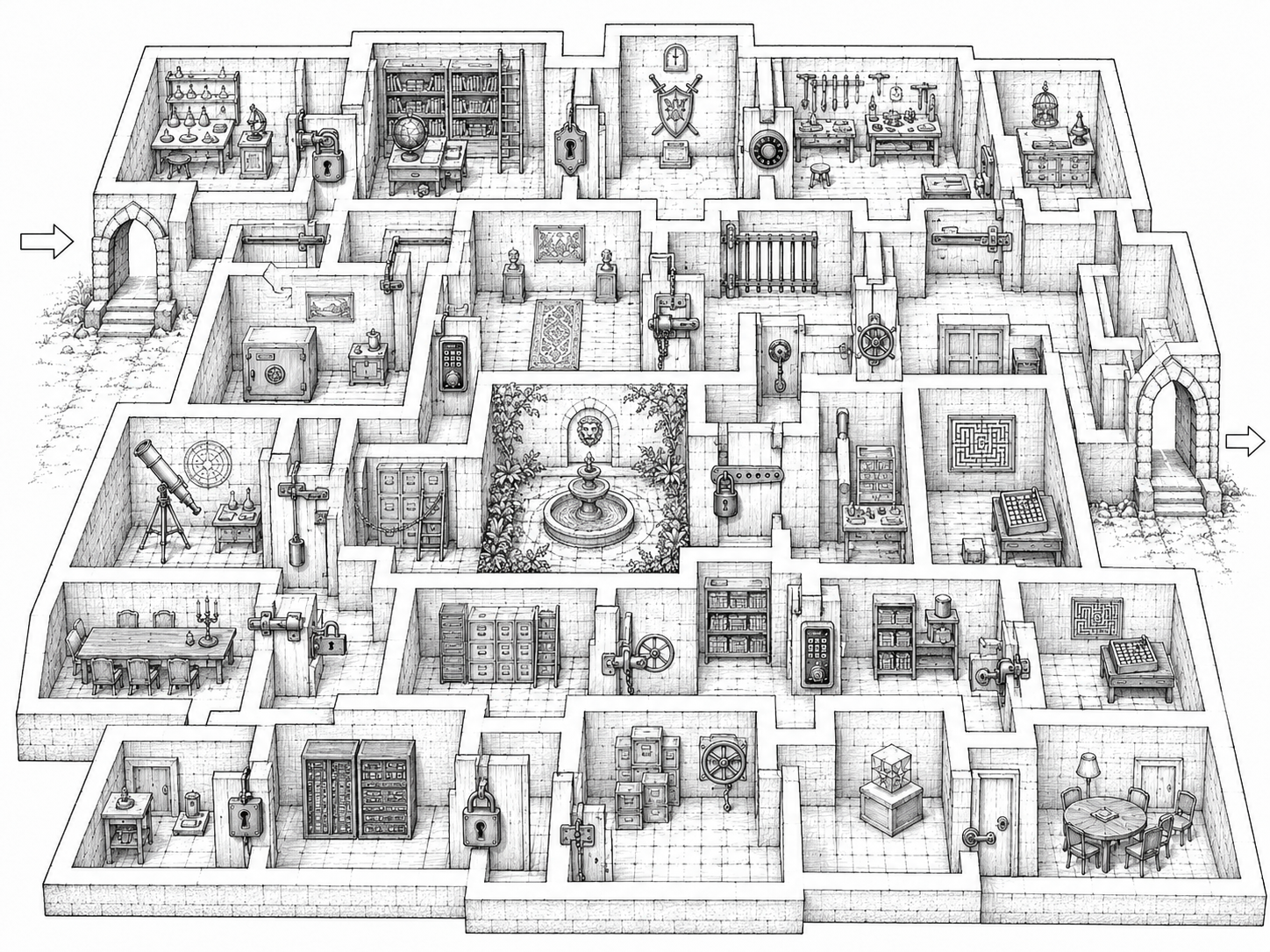
As an addendum, I am including both my original ChatGPT Plus prompt and a reconstructed version of the more elaborate prompt the ChatGPT Plus appears to have inferred in generating the image. The contrast is a reminder that AI can interpret, expand, and restructure its instructions.
My original prompt: "Create a line drawing of interconnected rooms each with a different type of lock and key. Getting from one side of the room to the other requires navigating through an array of different locked passageways."
ChatGPT’s interpretation of my original prompt: “Create a detailed black-and-white line drawing of a labyrinth of interconnected rooms, shown in an isometric cutaway or architectural floorplan style. The rooms should be connected by many doorways and passageways, each secured by a different kind of lock or locking mechanism—padlocks, keyholes, bolts, chains, combination locks, wheel locks, keypad locks, and other varied devices. The image should suggest that getting from the entrance on one side to the exit on the other requires navigating through a complex array of locked passageways. Include a variety of rooms with different contents or purposes so the system feels intricate and varied. Make it monochrome, pen-and-ink, crisp, serious, and diagram-like, with no people and no text.“
My comment on the image itself: “My initial reaction to version 1 was “wow” but some of the locked rooms went nowhere, which was the opposite of what I intended. The image I finally selected and posted above was the result of several iterations with the AI. It still has problems but gets the idea across.”