Dennis Howlett’s The poverty of enterprise 2.0 and social media, once you get past the hyperbole of the title and ZDNet’s antiquated requirement to register in order to leave comments, makes some good points.
Howlett points out the fuzzy thinking and evangelism that has turned off a lot of corporate IT managers about social media in the enterprise. Fortunately, the tide is turning. Real world stories of enterprise adoption of social technologies continue to emerge; see, for example, John Bell’s recent Corporate Blogging Grows Up.
Still, there’s more to “enterprise web 2.0” than outward-facing corporate blogs, even though their production always raises tricky control, privacy, and honesty issues. Howlett focuses on the corporate IT department’s role, which is an area that I have also addressed in the past when I first became interested in “things web 2.0.”
What I’ve concluded is that the corporate IT department needs to be involved in technology related social technology initiatives, but it can’t necessarily lead the charge. There are two factors at work here.
The first is that social technology initiatives frequently involve more time, energy, and cost associated with process change than they do with technology itself. This is how I usually picture such initiatives in my mind:
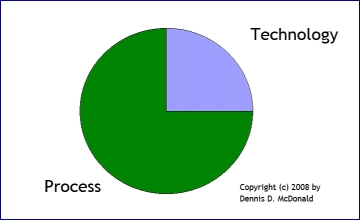
The second factor is that corporate IT is well situated to understand the security and support implications of initiatives involving technology, even when such initiatives involve remotely hosted applications that, initially at least, don’t require heavy duty integration with corporate systems and data stores.
Furthermore — and this I’ve seen often in working as a consultant with corporate IT departments — IT staff are significantly more expert in their understanding of project management practices than departments that are less experienced with project oriented work.
This, I think, is one of the reasons that IT departments are often viewed as throwing roadblocks in the way of corporate technology-related initiatives that arise elsewhere within the enterprise, when what they are really concerned with is that the know what’s involved in getting the job done.
- Copyright (c) 2008 by Dennis D. McDonald