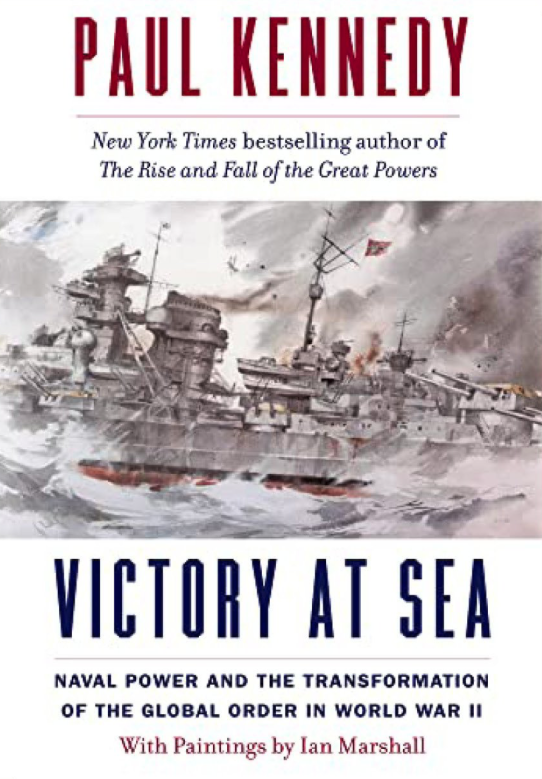
Paul Kennedy's “Victory at Sea”
Review by Dennis D. McDonald
This massive volume explains the critical roles naval power played on all sides in World War II. Kennedy weaves together how technology, strong personalities, economic and industrial resources, and even sheer luck all contributed to the eventual—and in his telling, inevitable—Allied victory.
By now, the rising importance of aircraft and aircraft carriers in World War II is well understood, especially how older doctrines centered on massive guns and battleships were overshadowed. Kennedy explains the forces that shaped these new resources between the wars and how post–World War I treaties and political sentiments influenced how England, the United States, Germany, Italy, France, and Japan prepared—navally—for the next conflict.
He also conveys the vast scale and distances involved in naval warfare during the war and demonstrates how aircraft carriers displaced battleships; Japan’s recognition of this shift was demonstrated all too clearly at Pearl Harbor.
One of the book’s great strengths is Kennedy’s use of numbers, tables, and charts, which he presents in clear and understandable ways, even in the audiobook version I’m listening to. Many history books are difficult to follow in a voice-only format, but Kennedy succeeds in making scale, size, and distances, especially in the Pacific theater, comprehensible.
My main criticism is the limited discussion of the human toll. Battles, ships sunk, bombs dropped, and planes lost are reported with precision, but the experiences of those who fought and died are largely absent. I realize this may not be the purpose of the book, but I hope the later chapters—still ahead of me—address this human dimension. Without it, accounts of warfare’s scale and scope feel incomplete, much as they do in other media when the human element is overlooked.
Finally, the book demonstrates how rapidly air power and aircraft carriers transformed naval warfare and how these changes were largely unanticipated by “old guard” admirals between the wars. As an armchair historian, I can’t help but wonder whether we are at a similar turning point today. Hypersonic missiles, drones, submarines, and other technologies may have already rendered aircraft carriers undefendable and obsolete. Protecting them against such weapons seems hopeless, no matter how much technology, money, or manpower we devote to creating defensive “shields” around them.
Review copyright 2025 by Dennis D. McDonald