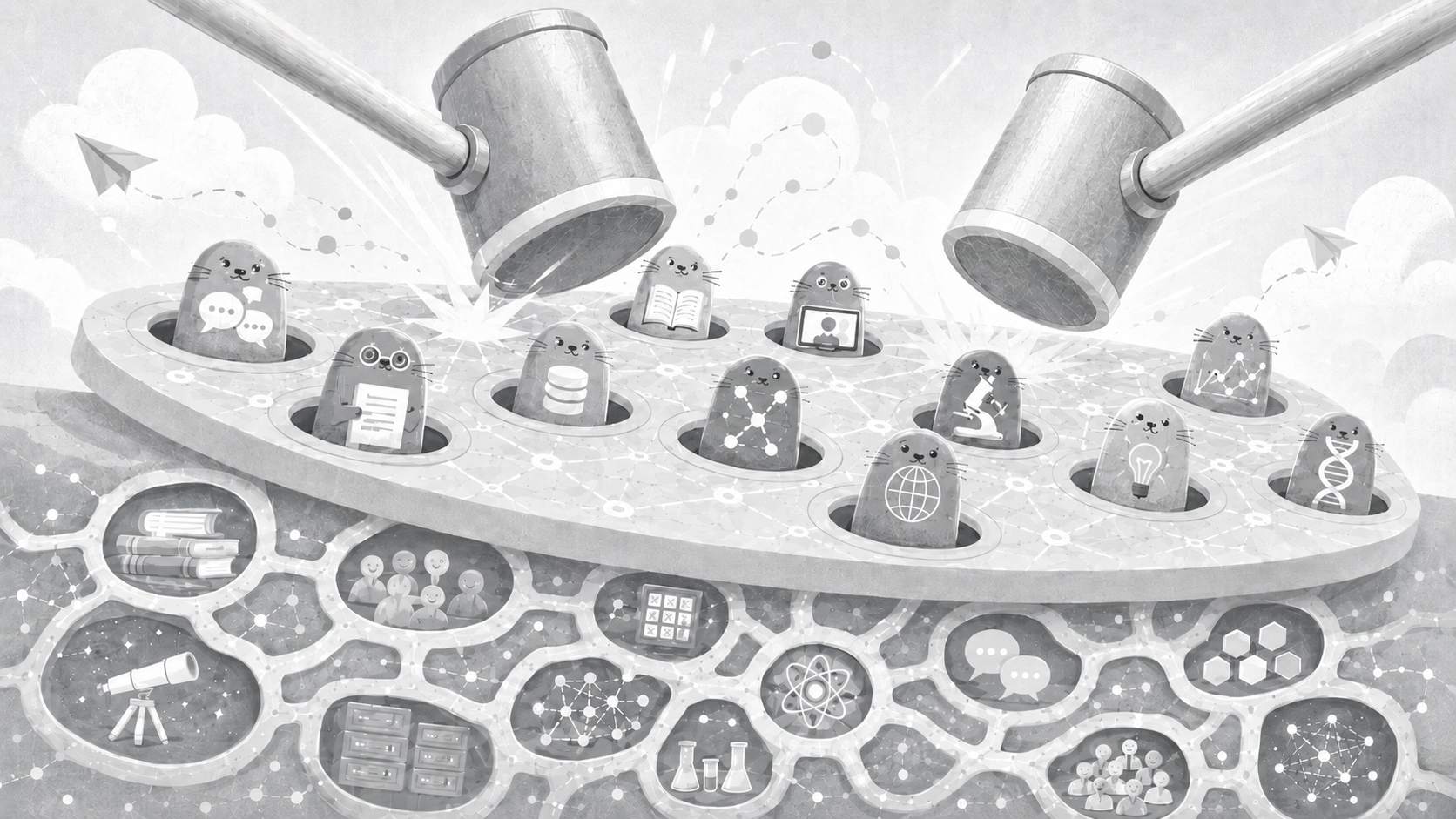
Is the Trump Administration Playing Whack-a-Mole with Scientific Communication?
The ability to communicate with one’s peers has always been central to how science advances. One’s findings are scrutinized by others, discussed, and fed as input into others’ research, many times in original or even surprising ways. Entire ecosystems, both formal and informal, consist of meetings, publications, shared databases, and even social media networks. These systems have evolved to support communication via interactions that are both one-way, or broadcast, and two-way, or interactive. Another consideration is that widespread access to scientific research also increases the likelihood of potentially important serendipitous discovery.
Government funding in the U.S. has always been critical to what research is performed and how it is communicated. According to Alexa Romberg and Sylvia Chou’s editorial in Inside Higher Education, “The 3-Pronged Attack on Scientific Communication,” political appointees at NIH are now trying to exert more centralized control over how NIH-funded scientists communicate their research findings through three main controls:
Centralizing, and controlling, direct staff communications with the scientific community.
Censoring researchers across the country by increasing control over research proposals, for example, by using a text analysis tool that “routinely flags grants that contain words that the administration finds suspicious, such as ‘health equity’ and ‘structural racism.’”
Restricting health communication research that directly addresses topics such as “media literacy,” “misinformation,” and “persuasion.”
The administration may argue that it has a responsibility to ensure that public funds reflect public priorities. That is a strong argument, but it works both ways. By implementing research communication controls that reflect the administration’s policies and politics, the administration is saying that the traditional and, in some cases, illusory “firewall” between science and politics is no longer valid. That opens the floodgates for more political control, not only over what science is conducted but also over how that science is communicated.
Such controls explicitly insert the government into more components of the “research lifecycle” than it can possibly, in my opinion, sustain. My reason for saying this is that, since World War II, scientific research and its communication have become much more decentralized and fragmented. Governments still play a major role in funding research and the systems involved in communicating that research. At the same time, media and communication channels have made it easier than ever to communicate directly with specialized groups of one’s peers. One example is the ability to conduct scientific meetings electronically with participants who are geographically dispersed.
Peer-reviewed scientific journals may still be the “gold standard” for allocating influence, honors, and authority. Even there, however, preprints, page charges, open-access publications, AI-assisted editing, and subscription subsidies by large libraries and institutions are all influencing — some might say disrupting — the impact of traditional communication channels.
In other words, while administration entities such as NIH political appointees may think they can control how research is communicated, they may very well find themselves playing “whack-a-mole” given the numerous formal and informal channels that make up current scientific communication infrastructures.
This situation reminds me of the security and secrecy controls the old USSR imposed to hide its research into biological weapons during the Cold War. In those days, the Kremlin was able to hide these research efforts from Western eyes for many years through draconian secrecy methods. In today’s communication environment, would such controls be possible to maintain, despite the sensitive nature of the research being hidden?
I think not. Details would eventually leak out through whistle-blowers, network “back doors,” defections, or decentralized opponents of the regime who have access to a myriad of hard-to-control media. (See “When the Cold War Was Winding Down, Could the Soviet Military Have Maintained Secrecy Had Social Media Existed?”)
The most effective tool the current administration has at its disposal to control research communication is the power of the purse and its ability to cut off funding for research it finds unacceptable. We are seeing that happen. The results are already weakening the U.S. and its tradition of leadership in scientific research. That is fundamentally a political issue that U.S. voters must address.
Meanwhile, we can at least take some comfort in the fact that our decentralized networks for sharing research information cannot be completely sidelined, no matter how aggressively the current administration tries to control them.
Copyright © 2026 by Dennis D. McDonald. Image at the head of this article developed by ChatGPT Plus based on prompting related to the “whack-a-mole” concept.