MY CONTACT INFO

Office phone: 703-549-1030

Email: ddmcd@yahoo.com

SERIES: TOWARD A DEFINITION OF ENTERPRISE MOBILITY

Part 1: Key Dimensions:

go to web page

download .pdf

Part 2: Key Questions:

go to web page

download .pdf

Part 3: Ten Requirements for a Mobile Collaborative Project Management App

under development

« Domestic Media Interdependence and Beethoven's Third Piano Concerto | Main | Honest, I'm Not Opposed to Location Based Services! »
Tuesday
Aug312010

Getting Real about Project Management, Collaboration, and Communication

By Dennis D. McDonald

I’ve recently learned — and re-learned — some useful lessons while working with clients and teams on projects and large proposals. These include:

  • People adopt technology at different rates.
  • People collaborate and communicate in many different ways.
  • Some people don’t know how to collaborate.
  • Technology is a collaboration tool, not a collaboration solution.
  • Management needs to lead adoption and use of communication and  collaboration technologies.

My use of information technology to support project management seems to have come naturally. As an early-on gadget lover I gravitated towards data sharing technologies, web based publishing, and eventually to social media and social networking.

I’ve also found it’s a mistake to assume others share these same values. Even if they express willingness to collaborate, some project staff may require help from management or other team members learning how to use technology to support collaboration, especially if they’ve come together from a variety of organizations or backgrounds.

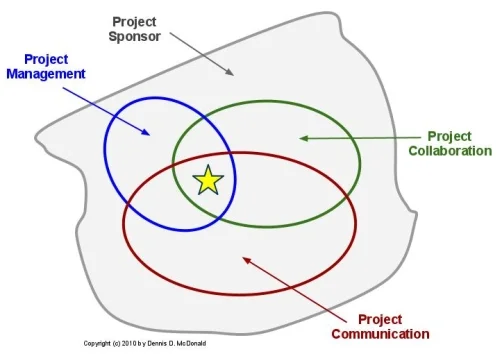
A typical project situation is where staff are working from many different locations and time zones on a time based project of some kind. Examples are developing a report, creating a proposal, developing a plan, or building and rolling out a product or application of some kind. Figure 1 displays a simple overview of how communication, collaboration, and project management can interact in such situations.

Figure 1. Project Collaboration map

All activities takes place in a “project sponsor” environment — a company, a government agency, a temporary team of companies or individuals, or some other group of resources bright together to accomplish a common objective. The three overlapping areas shown in Figure 1 are Management (guiding, leading, directing), Collaboration (working together to accomplish a common objective), and Communication (sharing information). I put a “gold star” at the intersection of the three.

It’s not sufficient for project management to focus only on managing project activities, deliverables, schedules, and budgets. Management may need to orchestrate how people communicate and collaborate, hence the gold star. This means providing leadership not only in defining tasks, responsibilities, and expectations — typical “project manager” duties — but also leading in the sharing of  information and in working together with different individuals and groups to accomplish necessary objectives.

Management needs to provide and use the tools:

  • If a collaborative document creation and editing system is being used to create a complex document, management needs to (a) use the tool itself, (b) make it known to those refusing to use the tools that they could be threatening the project’s schedule and budget by imposing extra costs, and c) make sure everyone knows how to use the tool! (If you’ve ever had to integrate changes made to separate Microsoft Word documents the day before a large proposal is due you’ll know what I mean!)
  • If a common calendaring or resource tracking system is available to staff members, management needs to (a) use the tool, (b) require its use when groups or individuals don’t make the effort to schedule group activities using the tool, and c) make sure everyone knows how to use the tool! (For example, don’t just toss a Basecamp application into a large mixed group and expect everyone to know how to configure and use it!)

Look again at Figure 1. You’ll see a lot of space outside the “gold star” intersection. Not all communication or collaboration can — or should — take place with the knowledge or involvement of management, and not all communication involves collaboration and vice versa. People are going to use their existing tools and skills; you wouldn’t expect anything different from any group of professionals, would you?

I still maintain, based on my own experience, that if management does not pay attention to the intersection of all three, project failure can result. Some of this management involvement involves imposing structure and discipline and making responsibilities and expectations clear and understood by all. This is partly so that spontaneous “outside the gold star” collaboration and communication emerge within a shared context — even if the actual methods adopted by staff are unique or even incompatible with what others are doing.

For example, a senior member of the team may only know about how to use email and attachments to share files and may resist using a shared document using collaborative when working with a large group. Inevitably the problem of incompatible versions or out of sync revisions rears its ugly head, usually at the worst possible time.

Even more subtle issues come into play when sharing documents even from a central location. File naming conventions need to be enforced and that means that someone may have to play the role of the enforcer. Also, despite ubiquity of Microsoft Office applications there will arise incompatibilities due to multiple versions of Word or lack of universal access to tools such as Visio. Some one usually has to step in to convert, or standardize — or impose order. And when that happens in a temporary or volunteer situations, feathers can get ruffled if things aren’t approached diplomatically.

It’s always useful to remember that, just because you define a process and provide an underlying set of tools to support that process, not everyone will understand or be ready — or willing — to apply that process. What do you do if you’re managing a proposal and a key volunteer member doesn’t follow the process — “fire” him or her? Or suck it up and figure out a work-around?

Remember, it’s called “collaboration” for a reason. It’s about working together towards a common goal.

Keeping that in mind really helps when you need to balance the seemingly obvious advantages of standard systems and procedures with the reality that team members’ communication and collaboration behavior are learned over a long period of time and may be very difficult to change overnight.

Copyright (c) 2010 by Dennis D. McDonald

PrintView Printer Friendly Version

EmailEmail Article to Friend

Reader Comments (8)

This really is a brilliant post Dennis. I have compared teams and learning groups, not as a black and white intention, but as a springboard for thinking. And think, like yourself, that project managers need to think about leading communication and collaboration as the new edge...which creates plenty of consulting work for us :p
http://johntropea.tumblr.com/post/1050205553/of-course-there-are-gradients-cops-can-have-an

Our KM leader is currently thinking about this...but which Project Managers will be keen to give it a try. The first key is you need people to listen, and for that you need existing relationships...you need to be connected and know projects managers. eg. our KM lead knows lots of project managers, whereas I don't, so whether a lead is into KM or not doesn't really matter in this context, what's important is you need to know people that matter. Secondly which Project Manager will make time or take the risk in a new approach. We have to find mavericks or find project managers that have an interest in KM. We don't want to boil the ocean, we just need a couple of projects to pilot. It's not just about new tools it's about a willingness to behave differently or enhance communication and collaboration...and the project manager needs buyin from their team as well.

What are your thoughts in attracting a sample of Project Managers...as far as I know they aren't demanding KM.

NOTE: Yes, it's always about the people, but the tools are important, actually the design of the tools. If they are designed to how people think and behave and don't use terminology like blogs and forums, but rather "messages" then I think they will be more subtle and less foreign. Even better if things like blogs and forums are features of existing tools eg. comments stream for documents, microblogging on an element in MSProject which shoots off a message to people...

Anyway, this is the next movement whether we like it or not as it has become the new edge, Henry Mintzberg talks about the focus of your post in relation to the organisation as a whole, which he calls community-ship.
http://johntropea.tumblr.com/post/632299876/leadership-is-about-individuality-leadership-is

BTW - you may like this article about project managers and behaviours
http://cio.co.nz/cio.nsf/read/FFC6F31B395FBD5BCC25740500038A46
I have clipped the bits l liked
http://johntropea.tumblr.com/post/1000450093/set-goals-for-behaviour-not-targets-for-performance
http://johntropea.tumblr.com/post/1000439942/cognitive-feedback-insights-into-relationships
http://johntropea.tumblr.com/post/1000428616/mental-model-bias-of-meeting-targets
http://johntropea.tumblr.com/post/1000331634/as-projects-get-more-complicated-managers-stop
September 1, 2010 | Unregistered CommenterJohn Tropea
John - thank you so much for the thoughtful comments and links!

Relative to project managers and KM -- I would never be one to argue against the value of systems that help us take advantage of what others know. The reality, though, is that project managers tend to focus on the problems at hand not on building and sustaining repositories of knowledge. At least if we focus on making collaboration easier -- which includes making it easier to discover useful collaboration partners -- we'll make it easier for project staff to pick the brains of the people who are the real repositories of knowledge. That's one of the reasons, in my opinion, why focusing on the intersection between communication and collaboration makes so much sense.

- Dennis
September 2, 2010 | Registered CommenterDennis D. McDonald
Dear Dennis,

I really enjoy your blog posts. You are so right about your point that "people don't know how to collaborate". I was part of a team that designed a mock-up of a website that would allow collaboration between special education and general education teachers. The purpose of the site was to offer these teachers an online space where they could discuss a specific students educational needs and develop appropriate interventions or accommodations.
Our research on collaboration between teachers found they did not understand what collaboration was and many believed that listening to another teacher constituted collaboration. Based on this information and interviews of teachers in the workplace, we added a professional development component on collaboration to the website. This module included instruction on collaborative skills and how to collaborate as well as examples of teachers collaborating on projects in their schools.

On another note, I have a different perspective on project management. I see project collaboration being the encompassing circle in your diagram and project sponsor being moved to the center. I see project collaboration as an essential function in facilitating the interaction of those changing components utilizing technology or other tools to keep it flowing. What do you think?
September 15, 2010 | Unregistered CommenterMarian Casey
Marian-
Thanks you so much for the thoughtful comments.
Regarding your first point, I would like to know more about what you mean by "...instruction on collaborative skills." There are a number of environments where I believe that would be useful.
Regarding your second point -- you make a good point; I think one reason I put "project sponsor" where I do is that a given sponsor can have many different projects, all of which require management, collaboration, and communication. The sponsor's overall strategy should drive how these projects are staffed and managed. But expressing this in a drawing is a bit more than I can handle!
- Dennis
September 15, 2010 | Registered CommenterDennis D. McDonald
Just getting to my backlog - nice post, as always.
Two thoughts (from earlier posts) -

* Sometimes, it can be tough to balance the amount of detail you get into when communicating about projects (http://bit.ly/bCxx2y and http://bit.ly/9AMpS2)
* Very important to understand /empathize with all of your potential audiences (http://bit.ly/bjoDMo)
September 26, 2010 | Unregistered CommenterJim MacLennan
Jim -

I especially agree with your "A Plea for Empathetic Communication" post (http://www.cazh1.com/a-plea-for-empathetic-communication/) -- along these lines I am helped in my thinking by the old "RACI" distinction -- see http://www.ddmcd.com/raci.html . Matching the content and channel to the audience -- and the audience's real need -- is a challenge now that we potentially have so many channels available for project communication. Just as the PM shouldn't only rely on a weekly or monthly status report to make progress information available, the CEO shouldn't have to wait until then, either.

Thanks for the comments and for the links!

- Dennis
September 27, 2010 | Registered CommenterDennis D. McDonald
Hi everyone
I have seen one website and I would like to share with you. It is <a href="http://www.workforcetrack.com/"> Workforcetrack.com </a> it has lots of business tools to use such as CRM, Project Management, Accounting and Finance, HRMS and many others but the best part is that they have android and iPhone apps, so may control and manage everything even being out. NJoy!!!
June 2, 2011 | Unregistered CommenterJulien Dimas
This is specifically what i was looking for. thanks for your time for the educational article and keep up the very good work.
July 7, 2011 | Unregistered Commentermarton

PostPost a New Comment

Enter your information below to add a new comment.
Author Email (optional):
Author URL (optional):
Post:
 
All HTML will be escaped. Hyperlinks will be created for URLs automatically.