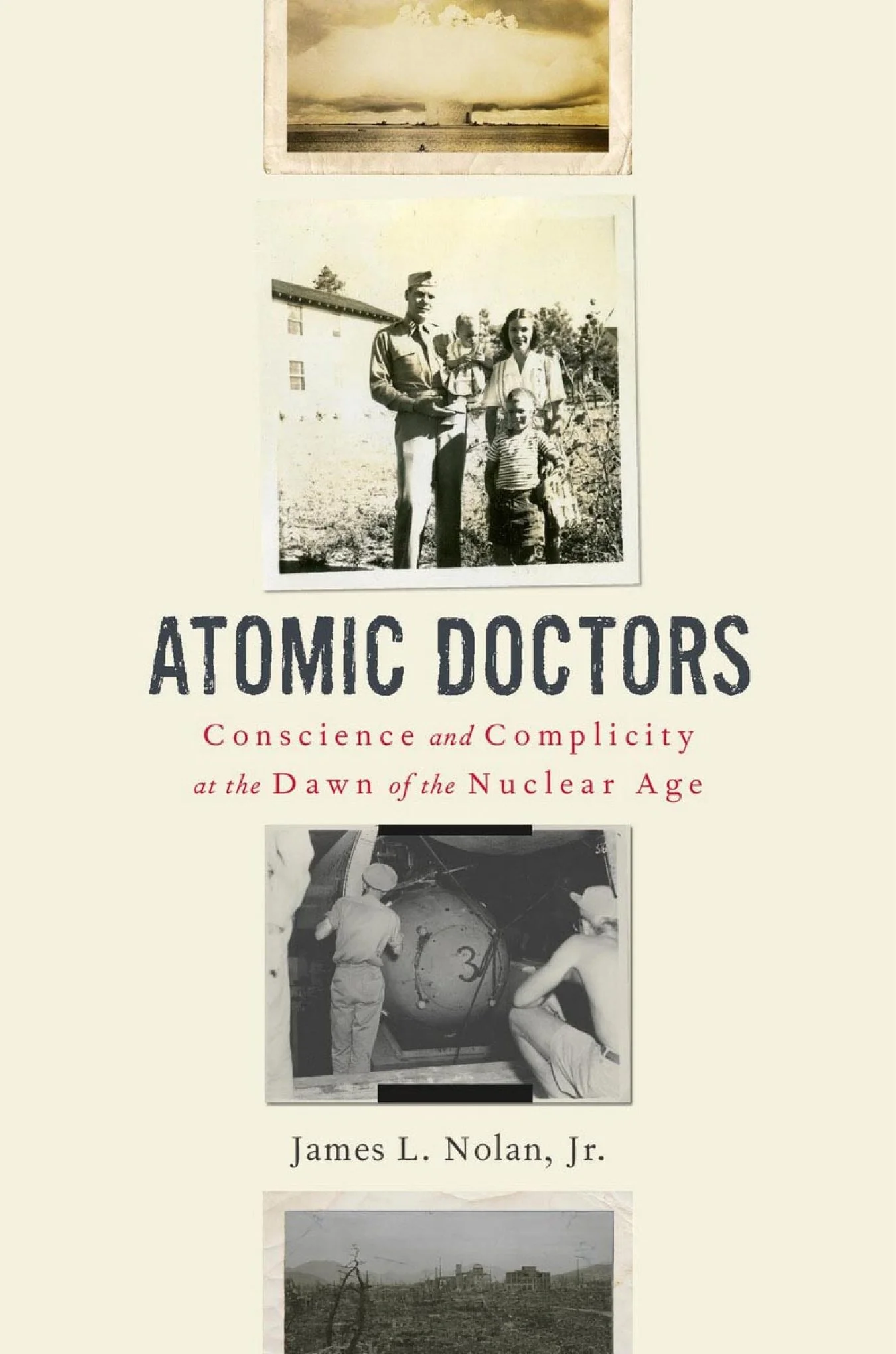
James L. Nolan Jr.’s "Atomic Doctors: Conscience and Complicity at the Dawn of the Nuclear Age"
Book review by Dennis D. McDonald
AI-generated summary: James L. Nolan Jr.’s Atomic Doctors tells the story of his grandfather, Dr. James L. Nolan, a physician who served at Los Alamos and witnessed firsthand the medical and moral challenges surrounding the creation and use of the atomic bomb. Through Nolan’s experiences—from developing early radiation safety protocols to assessing the human toll in Hiroshima and Nagasaki—the book exposes how scientific knowledge was often manipulated to serve military and political goals.
James L. Nolan Jr.’s Atomic Doctors: Conscience and Complicity at the Dawn of the Nuclear Age is both a personal and historical exploration of the moral and medical dilemmas that accompanied the birth of the nuclear era. The book focuses on the author’s grandfather, Dr. James L. Nolan, one of the first physicians recruited by J. Robert Oppenheimer to serve at Los Alamos during the Manhattan Project.
Dr. Nolan’s initial duties centered on managing the Los Alamos hospital, but his responsibilities quickly expanded to include developing radiation safety procedures for laboratory staff—a field that was at the time in its infancy. Measurement techniques and understanding of human radiation tolerance were still evolving.
In 1945, Nolan was one of three Los Alamos staff members assigned to accompany atomic bomb components aboard the ill-fated USS Indianapolis on their secret journey to Tinian Island, th elaunching base for the B-29 attacks on Japan. . The mission’s secrecy was such that the men used false identities and regularly monitored radiation levels of the lead-encased plutonium core they were transporting.
After delivery, Nolan’s team developed radiation safety protocols for both military and civilian personnel preparing for the B-29 bombing missions over Japan. Following the bombings of Hiroshima and Nagasaki, Dr. Nolan was part of the first U.S. medical team sent to Japan to assess the devastation and study the human consequences of the attacks. It was then that the full horror of radiation sickness became undeniable. The distinction between immediate radiation from the blast and lingering radiation from fallout became a politically charged issue. General Leslie Groves, head of the Manhattan Project, downplayed or denied the long-term dangers of radiation exposure—at times even misrepresenting scientific findings in congressional testimony—to preserve the perception that nuclear weapons were both controllable and militarily justifiable.
Nolan’s work placed him at the center of an enduring conflict between medical ethics and military necessity. The book reveals that, even in the earliest years of the atomic age, scientists and physicians were aware of the uncontrollable and deadly nature of radiation—knowledge that was often suppressed or manipulated for political reasons. Accounts of fatal laboratory accidents, such as the “tickling the dragon’s tail” experiments that produced lethal blue flashes of radiation, underscored the grim risks that accompanied the Manhattan Project’s pioneering work.
As the book progresses, Nolan Jr. broadens his focus beyond biography and history to explore the moral and philosophical implications of technological progress itself. In later chapters he reflects on how scientific and medical advances—particularly those tied to military or political imperatives—can blur ethical boundaries. These sections, written in an academic tone, delve into sociological and philosophical territory that some readers — including me — may find abstract or jargon-heavy. Still, the author’s attempt to situate his grandfather’s story within larger questions about science, conscience, and power is admirable.
Reading Atomic Doctors left me with a deeper understanding of the ethical tensions at the heart of nuclear research. As someone who has long viewed the use of atomic bombs through both historical and moral lenses, I came away with mixed feelings that remain unresolved.
From a World War II perspective, I still believe the bombings helped avoid an even bloodier invasion of Japan.
Viewed from today’s standpoint, I would have preferred a demonstration detonation to warn Japan and the world without inflicting such catastrophic civilian suffering.
Ultimately, Nolan’s book succeeds in humanizing the scientists and doctors who stood at the intersection of medicine, technology, and war—and in reminding us how the pursuit of knowledge can become entangled with power, secrecy, and moral compromise.
Significantly, we are today seeing such moral questions already being played out as AI tools and techniques become intermingled with daily life in ways that we can’t really predict—or control.
Review copyright (c) 2025 by Dennis D. McDonald