What Should AI Do in the STEM Classroom?
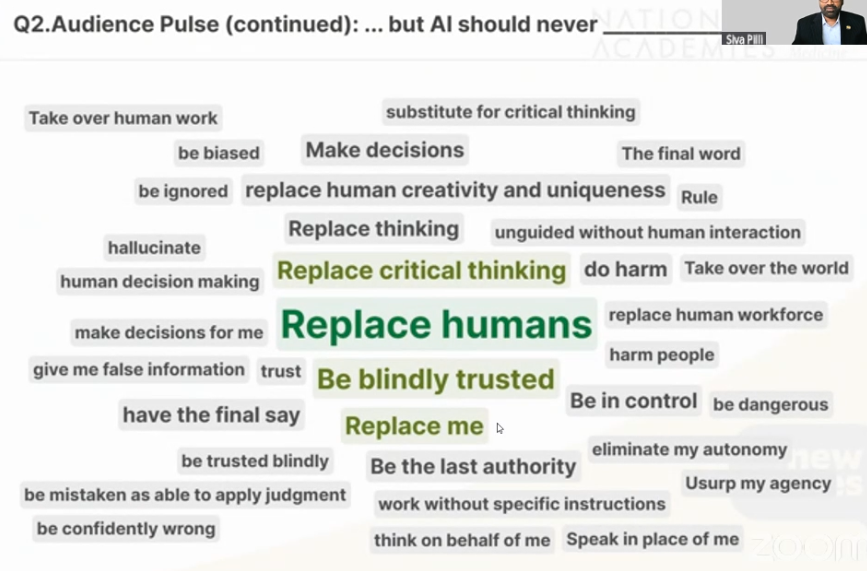
Today I attended a webinar sponsored by the National Academies, Leveraging AI for Effective STEM Learning and Workforce Development. The word cloud at the top of this article is a screen capture of one of the webinar’s displays.
I use AI a lot in my own work, and I wonder how it will affect the education of my grandchildren, who are 2, 4, 6, and 8. The webinar also took me back to 2009, when I consulted on a National Academy of Engineering study on promoting engineering careers to girls.
My particular focus back then was investigating how best to use social media to promote engineering.
My memory of that project is a bit fuzzy, but I do remember supporting an ongoing social media outreach program to share news with teachers about engineering, math, and what other teachers were doing.
Fast forward to today. The challenges posed by AI use in STEM education are very different from figuring out how to use social media to promote engineering to girls. We were using social media to support information sharing and collaboration focused on getting girls interested in engineering. One barrier the study identified was the perception that engineering placed a heavy emphasis on math skills, which appeared to discourage some girls from pursuing it.
Nowadays, of course, systems and methods for collaboration and information sharing are more robust, widespread, and available to both children and adults concerned with education. There are legitimate fears associated with using AI. The word cloud above shows how webinar attendees finished the prompt “… but AI should never ___.”
The sense I got from the various webinar presenters was that AI can be a very useful tool in education, especially in K–12 education, but there is still much variety in thinking about how much autonomy and decision-making responsibility AI tools should have in educating young people.
One of the big advantages AI teaching tools will have is their ability to adapt to the skills and learning styles of individual students. Students learn differently, and AI’s potential for individualized instruction is significant. If AI adapts instruction to each student, how does a teacher tell whether everyone is making progress toward the same learning goals?
Obviously this changes the role of the teacher. That was touched on by several webinar speakers as well.
One must be careful when working with the minds of young people. In AI Is Changing How I Work, Not How I Think, I wrote about how I use AI to speed up work I already know how to do or know how to manage. The speakers in today’s webinar instead are talking about a tool being used to help young people who are still figuring out how to think and behave. That’s a very different challenge.
I suspect that AI can help with that as well, which certainly places pressure on teachers to manage AI in the classroom effectively. I’m happy to see the National Academies focusing on this issue!
Copyright © 2026 by Dennis D. McDonald