On Using ChatGPT as a Writing & Research Assistant
Executive Summary
ChatGPT has become a useful research, editing, and analytical assistant in both my personal writing and consulting work, but I draw a clear distinction between using AI to support writing and asking it to replace the act of writing itself. I’ve found that AI can accelerate research, organize information, compare requirements, and improve spelling, grammar, and clarity, yet its usefulness depends on the quality of its source material and the judgment of the persons defining what is requested and interpreting its output. For me, the most productive role for AI is not to supply my voice, but to help me think, investigate, test, and refine what I want to say.
A Disappointing Experiment
I recently conducted an experiment: I asked ChatGPT Plus to draft a movie review from a set of bullet points I had written to express my reaction to a movie. I did not like the result. The text was certainly readable, but it did not sound like something I had written.
This got me thinking about how I use AI tools for personal and professional purposes in my consulting—and where I draw the line.
I should warn the reader: I find AI tools such as ChatGPT very useful. If you are morally or philosophically opposed to using them, read no further. My intent here is not to proselytize, but to describe my experience in hopes of helping others who may have similar questions.
I Like to Write
First, I like to write. That is why I have maintained this website for more than 20 years and why I enjoy providing one of my consulting services: using my writing and research skills to help IT contractors with proposals and other written content.
But, as anyone who writes for pleasure or for a living knows, there is much more to writing than simply putting pen to paper. There is the thinking and research that come before the words. Then there is the revising and editing that come afterward. Last but not least, there is the physical act of writing itself.
My primary focus here is on the first two activities, which is where I have found AI tools most useful.
Preserving One’s Voice
Returning to my experiment: before ChatGPT could generate text from my bullet-point list, I first asked it to convert a scanned image of the handwritten notes—written with one of my fountain pens—into an editable text file. Then I asked it to “convert the bullet points into an English-language review like the ones I have written in the past, with standard sentence and paragraph structure.”
It did so and generated a readable review, but I did not like the result. Why? It did not read like something I would have written. It accurately carried over the ideas in the bullet-point list, but the generated prose seemed bland and colorless.
Certainly, I could have edited the generated text into something more acceptable, but that would not address my chief concern: I like to write. I like to form words and sentences mentally and then experience the tactile sensation of putting them down on paper in a thoughtful sequence. I do, however, often ask ChatGPT to edit my own text for “clarity, grammar, and spelling,” which it does quickly and reliably without substantially changing my original tone.
AI as Research Assistant
I use ChatGPT and other tools before and while I am writing, especially when I am doing client work or conducting my own market research. I often use ChatGPT to investigate a particular topic I am writing about. I like the way ChatGPT and similar AI-based tools can display the sequence of steps they follow in researching a question, followed by a synthesis of their findings, usually annotated with links to the sources cited in the response.
I have used this kind of AI-based “documented search process” for both personal and professional purposes. I have found it not only time-saving, but also useful for uncovering relevant information I might never have retrieved through more traditional, time-consuming research techniques.
While writing, I also ask ChatGPT questions. Its ability to remember and refer back to prior conversations has proved to be both a time-saver and an occasional stimulus for further thinking. Some aspects of this back-and-forth, conversational style of research can, however, be overwhelming or even unnerving. If one does not explicitly limit the desired output, the amount of detail supplied can become excessive. It is often best to state a limit at the outset—for example, “Please limit your response to two pages of text without using bullet lists.”
Although an extended research “conversation” can help flesh out a particular question, I still find ChatGPT’s use of the pronoun “I” through a conversational software interface somewhat unsettling.
Editing Without Replacing the Writer
Have I incorporated facts or ideas put forward by ChatGPT into my own writing? Yes, especially when researching a particular question. Also, when I write for my own website, I do not have an editor. I often ask ChatGPT to check my work for “spelling, grammar, and clarity.” Professional editors can do much more than that, of course, as I am learning through my current research into writing a book. I certainly cannot afford to hire a professional editor for everything I publish on my labor-of-love website, www.ddmcd.com, but I do appreciate even the basic feedback ChatGPT can provide on my own writing.
Beyond Writing to Analysis
One thing I have not yet asked ChatGPT to do is to create something outright, such as “write a song” or “write a poem.” I am sure it could do so, but that would defeat one of my primary preferences: I like to write. In my consulting work, however, I can and do ask ChatGPT to perform tasks such as “summarize the requirements for this RFP” or “compare the experience requirements of this RFP with the public experience statements of these three potential competitors.” It can then present the results in whatever form I request.
Such activities are not what I would call writing. They involve synthesis, analysis, comparison, some decision-making, and, in certain cases, basic reasoning. These are all things I can do, of course, but the speed and thoroughness of the AI tool outstrip my own performance. We have therefore moved beyond mere “writing” into an arena of research and analysis that incorporates logical comparison and interpretation—work that human analysts can perform, but generally at a slower pace.
Based on these experiences, I have reached some preliminary conclusions about both the value and the limitations of AI tools in the kind of work I do.
Quality, Trust, and Judgment
First, the ability of AI tools to perform analytical and comparative work efficiently depends on the quality and information content of the material being analyzed. Having worked in IT project management and consulting for many years, I know that what companies say they can do on their public websites sometimes differs from what they can actually do or have done. Using such information as input to competitive or partnering research should therefore be considered only a first step in a serious marketing or business effort, no matter how “intelligent” or sophisticated the research tool may be.
Second, because AI-based analysis can expand and accelerate the front end of marketing or sales strategy research, it may increase—not reduce—the need for experienced executive judgment in interpreting the results.
This raises the question of how much one should trust what an AI tool says in response to a research question. Part of that trust depends on how familiar you are with the body of knowledge being queried and on how much that familiarity has informed the precise wording of your query. If the subject is governed by standard rules, principles, or methodologies that are widely understood and accepted, confidence in the AI response may be higher than it would be in a field that is less structured or historically consistent. Asking an AI tool to apply generally accepted accounting principles to corporate financial records is one thing; asking a factual question about a fictional body of knowledge is another—as I once discovered when asking about the source of the Atreides family’s wealth (see How Did House Atreides Make Its Money Before Arrakis?).
AI in Proposal Development
As a consultant, I am often involved in researching and writing IT-related proposals in response to RFPs. There is obviously much more to “writing proposals” than the physical act of writing or typing on a keyboard. The work may include comparing a proposal draft with an RFP’s stated requirements. Even when an AI tool applies a preliminary scoring system to evaluate a draft, its output is useful only if management interprets the results in a way that accurately reflects the company’s policies, experience, and strategy.
AI tools can certainly be trained to generate text in a manner and style that reflect the skills, knowledge, goals, and even personalities of those managing the writing process. This is especially true when the process is driven by a structured external requirement such as an RFP or by the need for a quality report that synthesizes and interprets data from multiple systems. But that process takes time, thought, and discipline.
A Human at the End
Still, as a writer at heart, I want to believe that if I am responsible for writing something—regardless of AI’s involvement—somewhere there is an actual human being reading it. But that is another article!
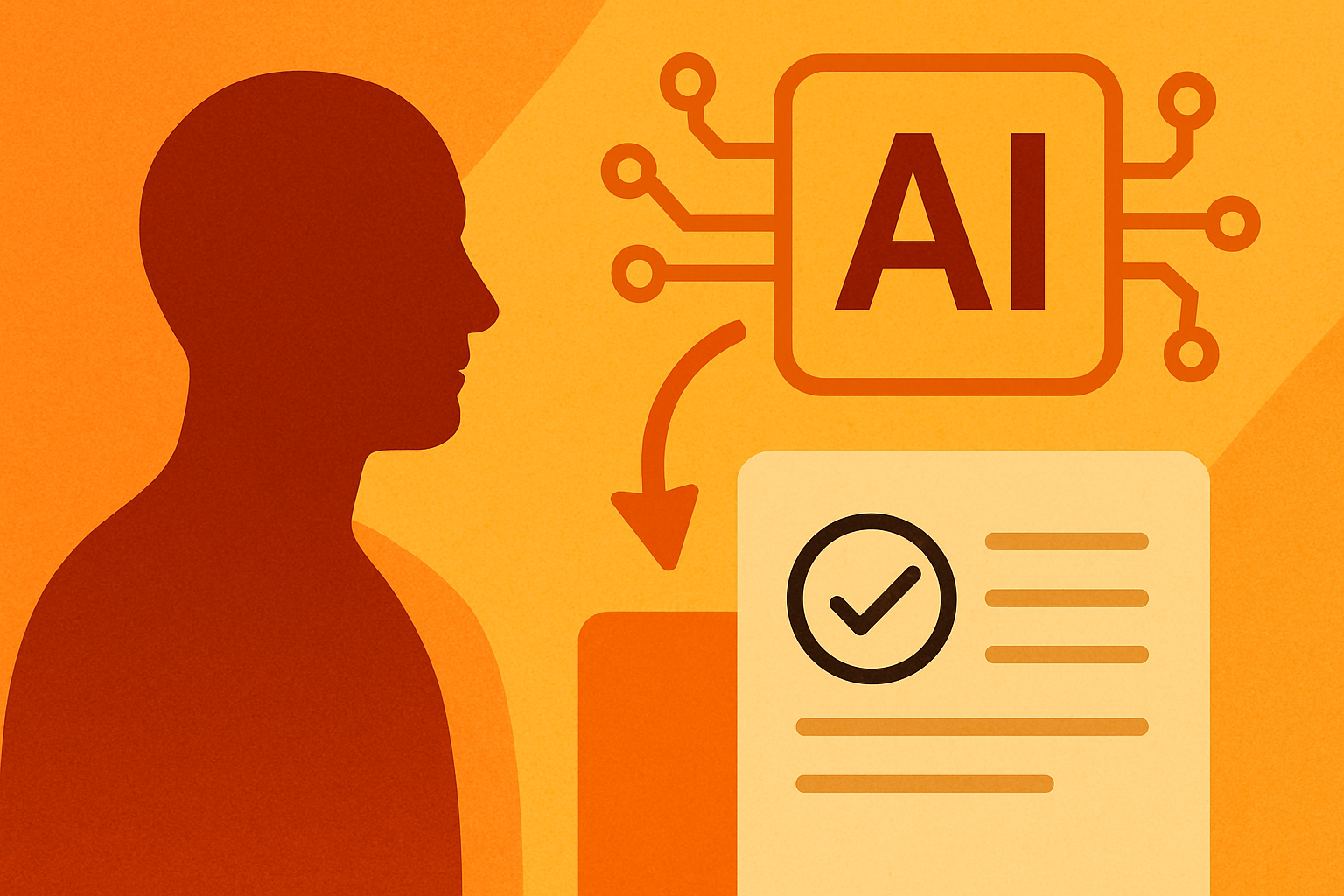
Copyright © 2026 by Dennis D. McDonald. Author’s note: at my request ChatGPT edited the raw text of this handwritten article for “grammar, spelling, and clarity” which I further edited; suggested subheadings for the different sections, created the executive summary at the top; and, generated the image via this initial prompt: “How about a line drawing to illustrate the article: one idea: author sitting at desk writing with fountain pen, sitting across from an artificial intelligence agent, having a conversation. Not cartoony. Perhaps with monochrome shading.”