If AI Answers Everything, Who Still Visits the Source?
I once worked for a company that published electronic encyclopedias, books, and illustrated parts catalogs on CD-ROM and local area networks. Back then I thought that full-text search was almost miraculous. Coming as I did from a background (libraries and publishing) focused on retrieval via structured indexes, controlled vocabularies, and discipline-specific thesauri, the very idea of being able to reach inside a document electronically using a well-constructed search statement seemed amazing.
Fast forward to the “do no evil” days of Google. By now the idea of searching and retrieving information using a “natural language” approach seemed old hat. What wasn’t old hat was how Google combined full-text search and an algorithm that ranked search output with an advertising model that accelerated the shift of ad dollars away from print publications.
For a time Google seemed unstoppable. People need quick answers. Google supplies them, or at least guides them to a web page or document that (hopefully) contains the answers.
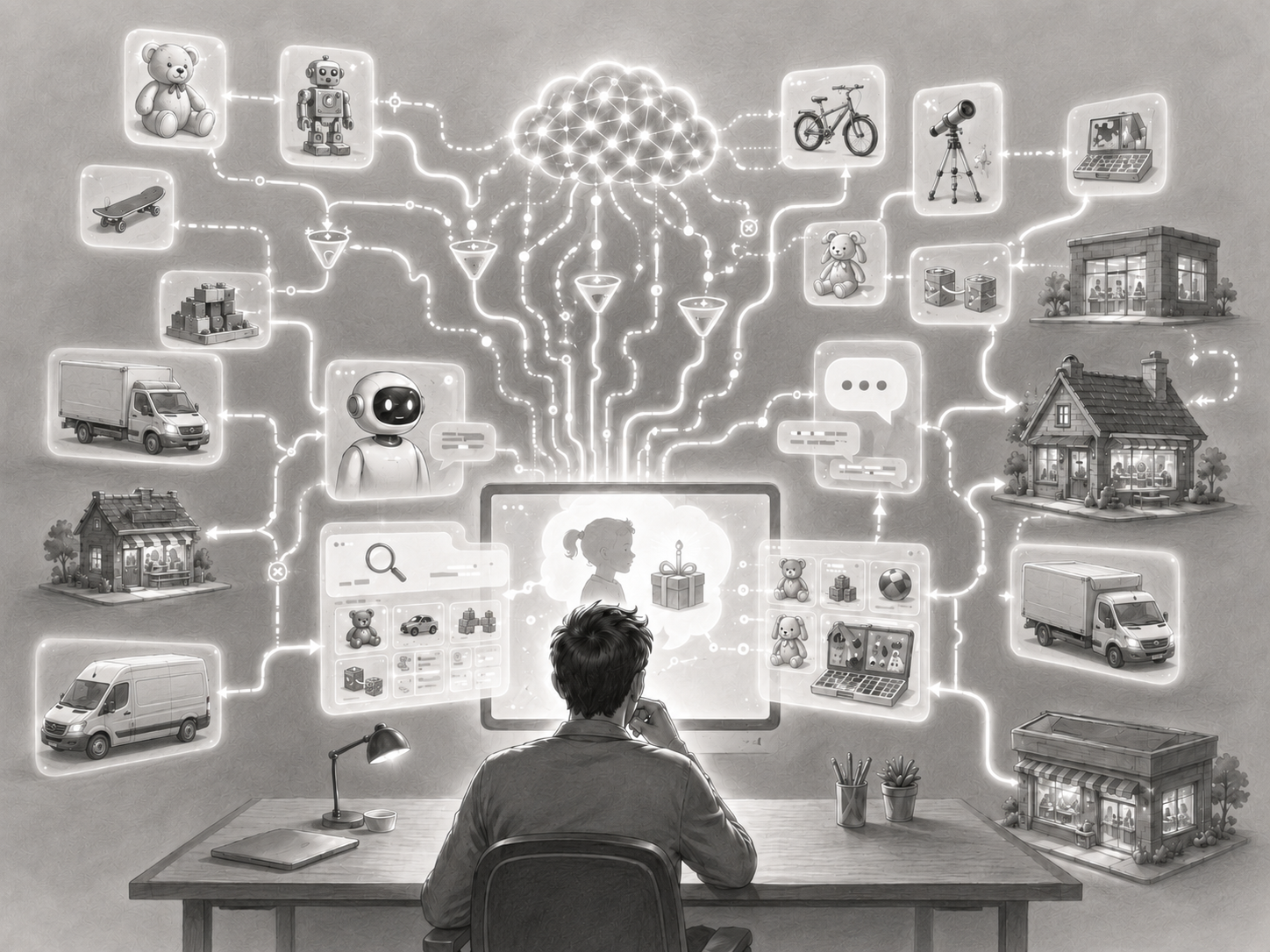
How that might be changing is described by TechDirt’s Glyn Moody in “Why Google’s New AI-Saturated Search Page Will Be a Disaster.” Moody’s basic point is that, with Google Search’s introduction of “a new era for AI search,” the need to visit an actual web page will be significantly reduced. AI will help formulate the search query via a conversational chatbot, then AI will search, analyze, summarize, and display the answer.
To be honest, I already rely on ChatGPT for this type of search interaction, and Google, as does ChatGPT, eventually enables a follow-on “conversation” that allows a question to morph, be redefined, and clarified.
Depending on how such conversations are guided, we are entering an era when expectations about how we use computers to interact with the world are bound to change.
Pretty soon those first-generation website chatbots and telephone answer trees (“Press one for…”) will seem outdated and frustrating. The future of customer support is already morphing as sophisticated underlying AI models support not just question answering, product selection, and ordering, but follow-up and complaint handling as well.
But as Moody points out, for Google and its search business this shift may very well reduce the need to visit the site that originated the answer. That has significant ramifications for traditional advertising and exposure models as well as pricing. As Moody says:
But these impressive technical features come at a high price, even leaving aside issues such as the environmental impact of the huge server farms they require. With the latest incarnation of its search engine, Google is making the World Wide Web as we have known it for over 30 years invisible, and therefore increasingly irrelevant to most people, who will be happy to let Google become their universal user interface to everything. And yet Google still depends on the Internet to supply all the information it is analyzing and repackaging. It risks killing the very thing that sustains it.
Moody concludes his piece with a warning that Google’s new AI tools might not just kill the goose that lays its golden eggs, they might even lead people to “offload basic activities to AI in a way that reduces their understanding of how the world operates.”
That may be true, but I don’t understand what is going on under the hood of my car, either; I’ve learned to trust it to get me from point A to Point B. Eventually, people may learn to trust Google as well. Or not. (There are other reasons why I rarely use Google’s search engine or other products, but that’s not relevant here.)
This shift to conversational AI-based interfaces does behoove people who produce and publish information online to think twice about the wisdom of their reliance on Google or other services to deliver users (and customers) to their doorstep. I would be thinking seriously about ways to reach my customers more directly without over-reliance on someone else’s intermediate AI-based interface, whose inner workings I can’t understand or control.
Copyright(c) 2026 by Dennis D. McDonald. For a description of the “conversation” with ChatGPT that generated the graphic accompanying this article, go here.