When a Tech Initiative Demands a Unified Approach to AI, Data, and Cybersecurity
Back in 2024, when I published Towards Unified Governance of AI, Data, and Cybersecurity Initiatives, I didn’t appreciate how quickly cybersecurity and AI governance would become central to managing organizations that depend on data.
When we change a business process, especially when we introduce new technology, we need to consider how data, AI, and cybersecurity interact. That holds even when responsibility for each is spread across the organization.
When a change to a business process affects how we manage data, AI, and cybersecurity, I start with four questions.
What are we trying to improve?
What crosses organizational boundaries?
Who can make the tradeoffs?
What should carry over to the next project?
What are we trying to improve?
Answering this question may be harder than it first appears, especially if we’re bringing in a tool or service that must be adapted to local requirements. Adaptation and customization take time and money. The more work they require, the longer it takes to see measurable improvements and the greater the chance that changes within the organization will force us to revise the plan.
We need to define the change tightly enough to give ourselves a chance to succeed and learn. The aim is to choose a significant process change with a manageable scope, so we can apply what we learn to other problems involving data, AI, and cybersecurity.
From a project management perspective, that means keeping a close eye on scope and having clear procedures for managing changes. The broader the process change, the more likely it is to affect how the organization manages AI, applies cybersecurity controls, and governs its data. We need to understand those effects at the outset, especially given how quickly AI capabilities and cybersecurity threats are evolving.
What crosses organizational boundaries?
Look at which departments have a role in the process and whether it depends on data from inside and outside the organization. Both can affect who needs to be involved and how readily people can adopt the change.
Decisions about AI policy, data governance, and cybersecurity response often involve more than one department. Even when IT leads the implementation of a new system, project oversight should include departments that may need to change how they respond to new AI capabilities or cybersecurity threats. Departmental representatives need to attend oversight meetings and be available to respond to last-minute changes or problems as well.
Who can make the tradeoffs?
Any consultant who has recommended a technology change to a committee knows how hard it can be to get a decision when someone must give up or share responsibility. Coordinating the governance of data, AI, and cybersecurity can raise exactly that question. Who has the authority to make the tradeoff when departments disagree?
The politics of sharing control matter even when one person or department leads the effort. That’s one reason to choose the problem carefully at the outset. A trivial change may leave important questions about oversight and control untested. Try to change too much at once and the effort can stall or fail.
What should carry over to the next project?
A process change that calls for a unified approach to data, AI, and cybersecurity can serve as a model for future projects. Collect, store, analyze, and report project data so the next team can build on what you learned. Capture how the project team kept decision-makers in different departments informed and involved, especially when decisions required their input.
It may be hard to keep a traditional RACI chart current as the organization and its operating environment change. Who is responsible, accountable, consulted, or informed may shift as the organization changes how it governs data, cybersecurity, and AI.
An Agile approach can also fall short if it focuses too narrowly on developing and testing software. Even when the team uses AI in that work, managers across departments still need to participate in decisions and oversee changes that affect their work.
In monitoring how government agencies procure cybersecurity support services, for example, I’ve seen too many treat cybersecurity primarily as a tool purchase. They cite standards such as those from NIST to specify technical requirements. At the state and local level, I’m gradually seeing some procurements also address the need to change how agencies govern cybersecurity in the face of changes posed by AI developments.
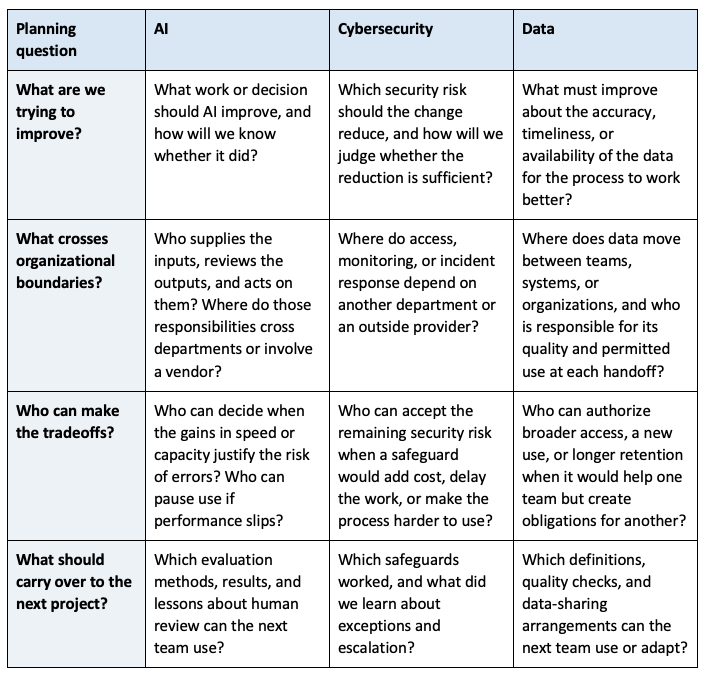
Governance Planning Matrix
The following are some of the questions that should be asked when planning an initiative involving AI, data, and cybersecurity.
Implications
Much of this draws on familiar project management principles. What’s changing, in my experience, is the pace at which technology forces organizations to revisit who makes decisions and how they make them. My sense is that smaller and newer organizations may be better able to adapt how they govern data, AI, and cybersecurity.
Even when an organization can move quickly, it still needs to weigh the costs of a governance change and consider how it will affect customers or other outside users. For example, strengthening cybersecurity controls in a financial process may change how people outside the organization use the system. Those effects deserve attention before the change goes into effect.
Copyright © 2026 by Dennis D. McDonald