How AI is Changing Government IT Procurement
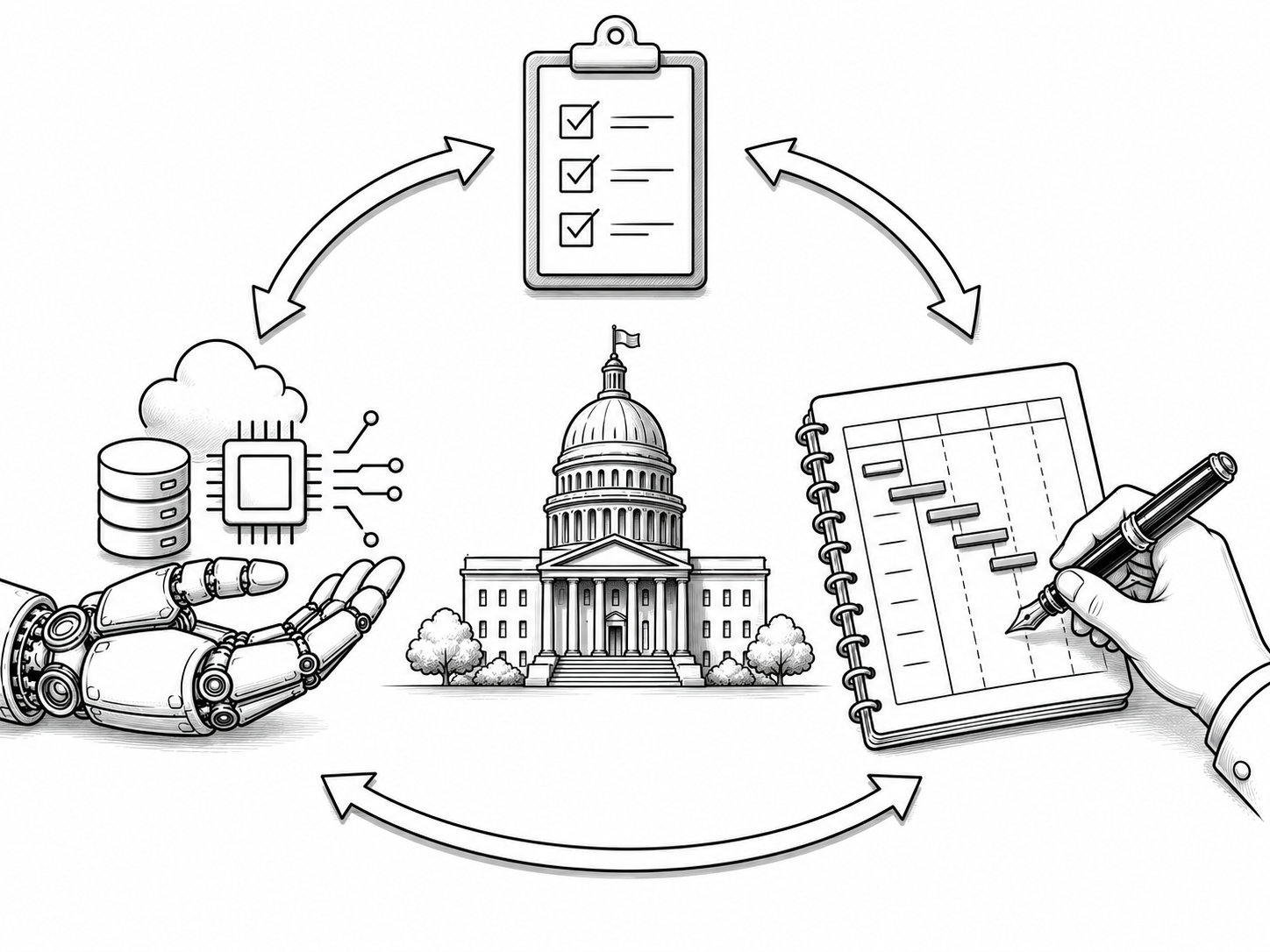
Artificial intelligence is changing government IT procurement in three basic ways that impact small and mid size tech vendors:
Changes in how IT products and services are procured.
Changes in the IT products and services procured by government agencies.
Changes in how vendors respond to #1 and #2.
1. Changes in how IT is procured
AI is changing how IT products and services are procured in several ways.
Procurement systems themselves are being modified to incorporate AI tools, an example being providing AI chatbots to procurement support.
Procurement officials are using AI tools to help research and define requirements for IT-related products and services.
One of the more significant changes I have seen while monitoring these markets is how there seems to have been a rise in the use of RFIs – requests for information -- and “sources sought” announcements compared to the total number of procurement announcements. State, local, and to some extent Federal agencies are using more RFIs to seek advice from vendors.
Perhaps many agencies are realizing that AI-related tools are potentially more transformative than prior technology innovations. Rather than simple replacements or upgrades that process data, these potential process disruptions can become reconfigurations of how agencies work.
The rise of AI may also be increasing use of RFIs prior to formal RFPs in this market as a way to ask vendors to speculate on how their AI-based offerings might benefit the issuing agency. In effect, agencies may be asking vendors for “free” consulting, but this also provides an opportunity for vendors to influence upcoming procurements to their advantage.
2. Changes to what is procured
Some government agencies appear seriously interested in how comprehensive and transformative AI-related services can become.
On the Federal side, for example, Department of Defense agency announcements in SAM.gov appear to be much more sophisticated analytically than those announced by civilian agencies.
At the state and local level, there appears to be an increasing number of announcements recognizing that AI support can extend beyond legacy system replacement to support for cross-system and cross-department process improvement.
Such changes call to mind the traditional category of “systems integration” projects where consultants managed changes to multiple systems in ways that demanded prior understanding of existing system operations, IT functionality, business processes, management priorities, and hands-on familiarity with relevant data.
Given the transformative potential for AI tools to change and hopefully improve how people interact with complex systems, I suspect that some of these more traditional systems integration capabilities will show up as requirements in the more sophisticated RFPs now emerging.
3. Changes to how vendors respond
How AI changes to how vendors respond to opportunities announced by government agencies requiring AI-supported tools will depend on the services to be offered. Government agencies are seeking:
Consulting and advice on AI transformation and IT modernization
Design and development of systems that incorporate AI
Implementation, training, and support for AI-enabled systems
All of the above
Given the risk-averse nature of much government IT contracting, my guess is that the market is initially likely to go to established vendors who already have market position with agency purchasing organizations as well as those who are already incorporating AI support into their offerings.
What this simplistic analysis does not take into account is the potential AI has for altering the “balance of power” in contractor supplied IT services. Areas impacted by AI application include coding, testing, market research, project management and administration, proposal development, and ongoing support. Can smaller (and potentially more nimble) firms employ AI to at least partially overcome the market advantage of larger more established IT contractors? I think so.
Thousands of purchasing systems exist in the US at all levels of government that announce business opportunities every day. Keeping up with potential opportunities has always been challenge especially when focusing on state and local IT opportunities. Many of these local and state procurement systems are already implementing AI support for how opportunities are summarized and how they can be searched by potential suppliers.
Depending upon your market focus, a small or mid-size IT vendor might find it necessary to register a company profile with multiple systems, with each system having its own process for vendor profiles, announcements, searching, and document access. Even systems that aggregate and announce opportunities from multiple systems can still require interacting not only with the aggregator but with the original issuing agency itself. This can be a frustrating process where inevitably one finds oneself reviewing many different retrieved opportunity descriptions to find just one to forward to management for their consideration.
I have found AI support to be critical for dealing with the variability across such systems. They all seem to have their own variations in how they interact with vendor service profiling and “standardized” commodity codes such as NAICS, NIGP, and UNSPSC. I have also found that “crosswalks” across commodity codes and different keyword combinations can be significantly helped through use of AI tools.
Conclusion
Just because AI is impacting all aspects of how government agencies procure IT services does not necessarily change the fundamentals of how individual vendors should behave. They must still discover opportunities, decide which to pursue, write proposals, and negotiate profitable contracts.
Vendors still must understand customer expectations, build relationships, and respond to vendor processes and market constraints.
At each step of the way, AI is enabling “more/better/faster.” How AI tools are employed to support business development must be carefully controlled, and this starts with an understanding of what you are selling and how flexible you are willing to be in selling it.
Copyright © 2026 by Dennis D. McDonald. Image created with assistance from ChatGPT Plus Image Generator (OpenAI).